Introducing the Agentic AI Trust Layer, Now Open for Public Preview





Key Takeaways
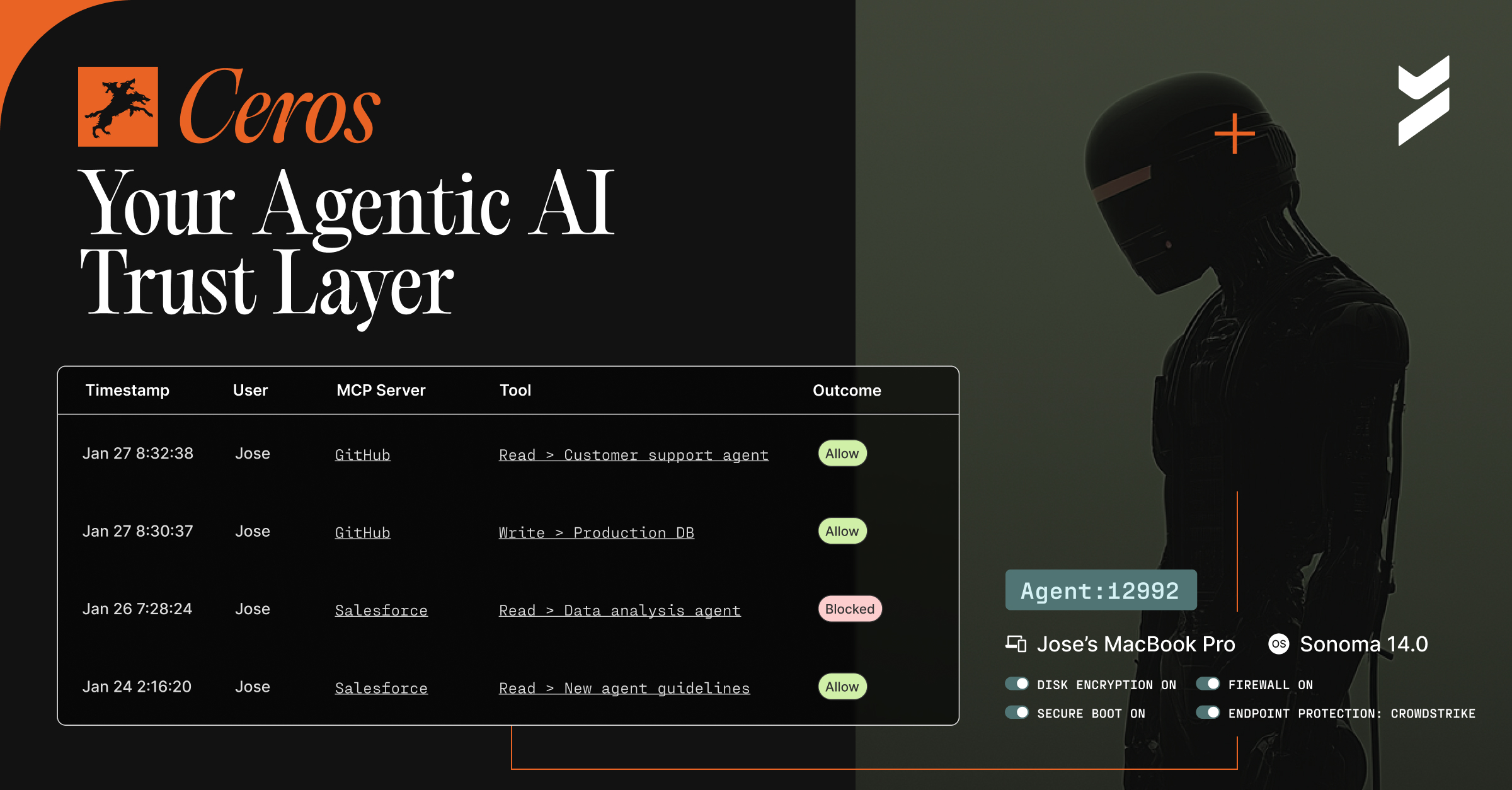
AI agents are accelerating engineering velocity at a blazing clip, but they're also opening new attack surfaces that traditional security tools can't see. Beyond Identity's AI Trust Layer is purpose built to let organizations adopt AI agents aggressively without giving adversaries a way in.
- Prevent credential theft: API keys are vaulted in hardware. Eliminate credential sprawl because attackers have nothing to steal.
- Block unauthorized access: Organizational policy is continuously evaluated before and during every session, ensuring only authorized users on secure devices can perform only approved actions.
- Block malicious tool use and MCP servers in real time.
- Trace every action: Every session is bound to a verified human on a verified device, so nothing goes unattributed.
We've spent the past few months building it with a select group of early access partners whose feedback shaped every aspect of the product.
Starting today, the product is free for any developer to sign up. It deploys securely in seconds.
What problem does the AI Trust Layer solve?
Your developers are already using AI agents. They're writing code, invoking tools, executing shell commands, and connecting to external services. It's happening right now, across your organization, and you have almost no visibility into any of it.
You don't know which agents are running. You don't know what data they're sending. You don't know whose API keys they're using or whether the machine they're running on is even secure.
And if something goes wrong, you can't trace it back to anyone.
The instinct is to slow things down. Lock it out. But the organizations that win will be the ones that figure out how to move faster with AI, not slower. The question isn't whether to let your teams use agents. It's how to let them use agents without opening security holes for adversaries to hitch a ride.
How does the AI Trust Layer work for agentic AI?
The AI Trust Layer sits between your AI agents and the services they connect to. Every API call, every tool invocation, every request flows through it before it reaches its destination. This gives you three things you don't have today: identity, observability, and governance.
Identity
Identity means every agent session is tied to a real person on a verified device. Not a shared API key that anyone can exfiltrate and replay. A specific human, on a specific machine, with a security posture your team has evaluated. For security teams, this means incident response goes from "someone used an API key" to "this person, on this device, at this time."
Observability
Observability means you can see everything. Every conversation, every prompt, every response, every tool call. Who ran it, when, for how long, and whether it succeeded or failed. For security teams, this is the audit trail that compliance requires and that incident investigations depend on. For engineering leaders, it's the data you need to understand how AI is actually being used across your organization.
Governance
Governance means you set the rules. You decide which agents can use which tools, which groups have access to which providers, and what device security requirements must be met before anyone can launch a session. For DevSecOps, this is the enforcement layer that turns security policy from a document into a runtime control.
These capabilities combine to create something that hasn't existed before in the AI tooling ecosystem: a protected zone for agentic execution. Only verified users, on compliant devices, using sanctioned tools, under enforced policies. Credential theft becomes irrelevant because stolen credentials are useless without the original hardware. Unauthorized access from compromised endpoints is blocked before it begins.
This is what separates the AI Trust Layer from monitoring tools that watch and report: it prevents.
Setup takes about 30 seconds
After signing up, installing the CLI wrapper is the entire setup. Your agent works exactly as it did before. The difference is that the AI Trust Layer now wraps every session in a secure trust substrate that authenticates the user, checks the security posture of their device, and enforces your policies before any request leaves the machine. Developers don't change their workflow. They don't configure proxy URLs. They just run their agent.
This matters because security that slows developers down doesn't get adopted. It gets circumvented. It was designed so that the path of least resistance is also the secure path.
For organization wide rollouts, it can be configured so developers simply run their agent as they normally would and are prompted to connect automatically. Security becomes invisible, which means it actually gets used.
Get Started
The AI Trust Layer is now open for public preview. Sign up and secure your first agent session in seconds.
Key Takeaways
AI agents are accelerating engineering velocity at a blazing clip, but they're also opening new attack surfaces that traditional security tools can't see. Beyond Identity's AI Trust Layer is purpose built to let organizations adopt AI agents aggressively without giving adversaries a way in.
- Prevent credential theft: API keys are vaulted in hardware. Eliminate credential sprawl because attackers have nothing to steal.
- Block unauthorized access: Organizational policy is continuously evaluated before and during every session, ensuring only authorized users on secure devices can perform only approved actions.
- Block malicious tool use and MCP servers in real time.
- Trace every action: Every session is bound to a verified human on a verified device, so nothing goes unattributed.
We've spent the past few months building it with a select group of early access partners whose feedback shaped every aspect of the product.
Starting today, the product is free for any developer to sign up. It deploys securely in seconds.
What problem does the AI Trust Layer solve?
Your developers are already using AI agents. They're writing code, invoking tools, executing shell commands, and connecting to external services. It's happening right now, across your organization, and you have almost no visibility into any of it.
You don't know which agents are running. You don't know what data they're sending. You don't know whose API keys they're using or whether the machine they're running on is even secure.
And if something goes wrong, you can't trace it back to anyone.
The instinct is to slow things down. Lock it out. But the organizations that win will be the ones that figure out how to move faster with AI, not slower. The question isn't whether to let your teams use agents. It's how to let them use agents without opening security holes for adversaries to hitch a ride.
How does the AI Trust Layer work for agentic AI?
The AI Trust Layer sits between your AI agents and the services they connect to. Every API call, every tool invocation, every request flows through it before it reaches its destination. This gives you three things you don't have today: identity, observability, and governance.
Identity
Identity means every agent session is tied to a real person on a verified device. Not a shared API key that anyone can exfiltrate and replay. A specific human, on a specific machine, with a security posture your team has evaluated. For security teams, this means incident response goes from "someone used an API key" to "this person, on this device, at this time."
Observability
Observability means you can see everything. Every conversation, every prompt, every response, every tool call. Who ran it, when, for how long, and whether it succeeded or failed. For security teams, this is the audit trail that compliance requires and that incident investigations depend on. For engineering leaders, it's the data you need to understand how AI is actually being used across your organization.
Governance
Governance means you set the rules. You decide which agents can use which tools, which groups have access to which providers, and what device security requirements must be met before anyone can launch a session. For DevSecOps, this is the enforcement layer that turns security policy from a document into a runtime control.
These capabilities combine to create something that hasn't existed before in the AI tooling ecosystem: a protected zone for agentic execution. Only verified users, on compliant devices, using sanctioned tools, under enforced policies. Credential theft becomes irrelevant because stolen credentials are useless without the original hardware. Unauthorized access from compromised endpoints is blocked before it begins.
This is what separates the AI Trust Layer from monitoring tools that watch and report: it prevents.
Setup takes about 30 seconds
After signing up, installing the CLI wrapper is the entire setup. Your agent works exactly as it did before. The difference is that the AI Trust Layer now wraps every session in a secure trust substrate that authenticates the user, checks the security posture of their device, and enforces your policies before any request leaves the machine. Developers don't change their workflow. They don't configure proxy URLs. They just run their agent.
This matters because security that slows developers down doesn't get adopted. It gets circumvented. It was designed so that the path of least resistance is also the secure path.
For organization wide rollouts, it can be configured so developers simply run their agent as they normally would and are prompted to connect automatically. Security becomes invisible, which means it actually gets used.
Get Started
The AI Trust Layer is now open for public preview. Sign up and secure your first agent session in seconds.
Key Takeaways
AI agents are accelerating engineering velocity at a blazing clip, but they're also opening new attack surfaces that traditional security tools can't see. Beyond Identity's AI Trust Layer is purpose built to let organizations adopt AI agents aggressively without giving adversaries a way in.
- Prevent credential theft: API keys are vaulted in hardware. Eliminate credential sprawl because attackers have nothing to steal.
- Block unauthorized access: Organizational policy is continuously evaluated before and during every session, ensuring only authorized users on secure devices can perform only approved actions.
- Block malicious tool use and MCP servers in real time.
- Trace every action: Every session is bound to a verified human on a verified device, so nothing goes unattributed.
We've spent the past few months building it with a select group of early access partners whose feedback shaped every aspect of the product.
Starting today, the product is free for any developer to sign up. It deploys securely in seconds.
What problem does the AI Trust Layer solve?
Your developers are already using AI agents. They're writing code, invoking tools, executing shell commands, and connecting to external services. It's happening right now, across your organization, and you have almost no visibility into any of it.
You don't know which agents are running. You don't know what data they're sending. You don't know whose API keys they're using or whether the machine they're running on is even secure.
And if something goes wrong, you can't trace it back to anyone.
The instinct is to slow things down. Lock it out. But the organizations that win will be the ones that figure out how to move faster with AI, not slower. The question isn't whether to let your teams use agents. It's how to let them use agents without opening security holes for adversaries to hitch a ride.
How does the AI Trust Layer work for agentic AI?
The AI Trust Layer sits between your AI agents and the services they connect to. Every API call, every tool invocation, every request flows through it before it reaches its destination. This gives you three things you don't have today: identity, observability, and governance.
Identity
Identity means every agent session is tied to a real person on a verified device. Not a shared API key that anyone can exfiltrate and replay. A specific human, on a specific machine, with a security posture your team has evaluated. For security teams, this means incident response goes from "someone used an API key" to "this person, on this device, at this time."
Observability
Observability means you can see everything. Every conversation, every prompt, every response, every tool call. Who ran it, when, for how long, and whether it succeeded or failed. For security teams, this is the audit trail that compliance requires and that incident investigations depend on. For engineering leaders, it's the data you need to understand how AI is actually being used across your organization.
Governance
Governance means you set the rules. You decide which agents can use which tools, which groups have access to which providers, and what device security requirements must be met before anyone can launch a session. For DevSecOps, this is the enforcement layer that turns security policy from a document into a runtime control.
These capabilities combine to create something that hasn't existed before in the AI tooling ecosystem: a protected zone for agentic execution. Only verified users, on compliant devices, using sanctioned tools, under enforced policies. Credential theft becomes irrelevant because stolen credentials are useless without the original hardware. Unauthorized access from compromised endpoints is blocked before it begins.
This is what separates the AI Trust Layer from monitoring tools that watch and report: it prevents.
Setup takes about 30 seconds
After signing up, installing the CLI wrapper is the entire setup. Your agent works exactly as it did before. The difference is that the AI Trust Layer now wraps every session in a secure trust substrate that authenticates the user, checks the security posture of their device, and enforces your policies before any request leaves the machine. Developers don't change their workflow. They don't configure proxy URLs. They just run their agent.
This matters because security that slows developers down doesn't get adopted. It gets circumvented. It was designed so that the path of least resistance is also the secure path.
For organization wide rollouts, it can be configured so developers simply run their agent as they normally would and are prompted to connect automatically. Security becomes invisible, which means it actually gets used.
Get Started
The AI Trust Layer is now open for public preview. Sign up and secure your first agent session in seconds.
Trending Resources

.png)
Your First 5 Minutes with the AI Trust Layer: See What You've Been Missing
February 24, 2026
The Attacker Gave Claude Their API Key: Why AI Agents Need Hardware-Bound Identity
February 2, 2026
Beyond Identity Opens Early Access for the AI Security Suite
January 22, 2026
Unlock High-Fidelity Security with the New Beyond Identity App for Splunk
January 16, 2026
Beyond Identity Joins NVIDIA Inception Program to Advance Hardware-Enforced Security for the AI Era
January 5, 2026

Chips and SLSA: Why TPMs Matter for Code Commits
December 19, 2025

Why Is Code Provenance Non-Negotiable in the Age of AI?
December 17, 2025
.avif)
How Beyond Identity & Nametag Stop Identity Fraud at Onboarding & Recovery
November 19, 2025
Make Identity-Based Attacks Impossible
August 11, 2025
Meeting CJIS Compliance with WDL
May 27, 2025
PCI DSS Compliance with Beyond Identity
March 6, 2025
.avif)
Online Job Board Safety: How and Why To Avoid a Scam
March 7, 2024

ChatGPT's Dark Side: Cyber Experts Warn AI Will Aid Cyberattacks in 2023
February 29, 2024
Improving User Access and Identity Management to Address Modern Enterprise Risk
February 20, 2024

Okta Cyber Trust Report
January 5, 2024

Securing Remote Work: Insights into Cyber Threats and Solutions
October 30, 2023

Networking Dinner with MightyID and Tevora
December 9, 2025
Alphinia CISO Mastermind Dinner
December 1, 2025

Myriad360 Client Appreciation Celebration
November 20, 2025
GuidePoint Security Movie Premeire of Wicked
November 19, 2025
.avif)
How AI Is Accelerating Threats: The Inside Scoop on Emerging Phishing GPTs
November 18, 2025

GuidePoint Security 3rd Annual Houston Golf Outing
November 13, 2025
GuidePoint Security's Pinehurst Golf Outing
November 12, 2025
GuidePoint Security Public Sector Vendor Fair
November 5, 2025